Showing posts with label non-romance. Show all posts

Monday, May 25, 2009

Sophocles: Antigone

Antigone


Let's awkwardly turn to another book that I read last month.

It's not a romance, not a fiction (well, not really), not a non-fiction, not a contemporary, not... many things, it is not, however, it is a book from my 101 books in 1001 days challenge. Hooray! (point for Alice.)

A brief background of the story (this is going to get even more awkward), starting with Oedipus.

Antigone is the daughter and sister of Oedipus, who killed his father and married his mother. It goes like this - Oedipus was fated to kill his father and marry his mother. His father, King Laius, heard and was horrified (rightfully so) and ordered for him to be left to die. His mother, Jocasta, gave him to a servant because she couldn't bear to kill her son, and the servant carried Oedipus to the next county, or kingdom, (or what-not) where he became the adopted son of the king and queen there.

Oedipus is unaware that the parents who raised him are not his biological parents and when he hears of his own fate, he is horrified (rightfully so) and runs away from "home."

While running away, he comes across an old man at a crossroads. They get into a fight and Oedipus kills the old man (aka Laius).

Times passes, and he solves a riddle from the sphinx that has been tormenting his homeland. It's solved, the sphinx is gone, and he wins the prize, which is the hand of the queen of the land, Jocasta.

They marry (ew!) and have four kids (double ew!): Eteocles, Polyneices, Ismene, and our star, Antigone.

Oedipus finds out what he's done, is horrified (duh) and flees the country. He later gouges out his eyes. Jocasta hangs herself.

And Eteocles and Polyneices fight - and kill - each other. Ismene and Antigone are horrified and unhappy (once again, this isn't rocket science).

In Antigone, Jocasta's brother, Creon, is king of the land. He orders Polyneices' body to remained unburied because he was a traitor to the country, however, Antigone desires a proper burial her brother.

Creon has declared anyone who buries Polyneices to be a traitor, a crime that will be harshly punished, but Antigone does it anyway. She is taken before Creon where she argues her point of view and her loyalty to the law of the gods, not to Creon.

She later hangs himself and Haemon, fiance of Antigone and Creon's son, argues with dad. Then he stabs himself. Creon's wife, upon hearing of Haemon's suicide, kills herself as well.

Creon is left, "humbled" and horrified by what has happened (rightfully so).


Not the happiest of stories, this Greek Tragedy was great in that Antigone, who previously seemed an unlikely candidate to be a heroine, proves herself worthy. She is aware of what she does and does not believe in, and most importantly, is able to act in a manner that reflects her beliefs. She is willing to take the consequences of her actions - not shying away from Creon when she is brought before him - and she argues with him (you go girl!).

The cons of this story: written in play form (kind of a pain), almost everyone commits suicide (did someone say Hamlet?), it is full of negativity, and I still don't understand the role of the chorus. I feel like they have more purpose than to provide with background info and current mood. (What's an antistrophe and strophe?)

It was fun to read something besides romance and I enjoyed the story.

Friday, May 8, 2009

Emily Giffin: Something Borrowed

Something Borrowed: C+
Chick-lit, women's fiction

An unexpected love affair threatens a long-lived friendship in this soap opera–like debut from Atlanta ex-lawyer Giffin. Since elementary school, Rachel and Darcy have been best friends, with Darcy always outshining Rachel. While single Rachel is the self-confessed good girl, an attorney trapped at a suffocating New York law firm, Darcy is the complete opposite, a stereotypical outgoing publicist, planning a wedding with the handsome Dex. After Rachel's 30th birthday party, she knocks back one drink too many and winds up in bed with Dex. Instead of feeling guilty about sleeping with her best friend's fiancé, Rachel realizes that Dex is the only man she's really loved, and that she's always resented manipulative Darcy. Rachel and Dex spend a few weekends in the city together "working" while Darcy's off with friends at a Hamptons beach share, but finally Rachel realizes she'll have to give Dex an ultimatum... (Publisher's Weekly)


Here is a book that I loathed to read. Really, really loathed. There are many reasons as to why I would have never even touched this novel.

1. I hate reading about cheaters
2. Rachel, the heroine, cheats with her best friend's fiance.
3. I hate cheaters.

"But Alice," my book buddy Nancy said to me, "just try it."

And so, I did, with mixed feelings. And all through the book, I read with mixed feelings.

This book is not a romance. It, however, is a book about friendship, about relationships, and about self and on discovering who you are.

The gist of the story is this: Rachel turns thirty. She has a party, with of course, her best friend, Darcy, who is gorgeous and everything Rachel is not. Rachel is smart and intelligent, but more Plain Jane than anything else.

So she turns thirty. She gets pretty drunk. She and Darcy's fiance, Dex, are on their way home when ...one step after another, they get to her place, and they do the unthinkable.

What was so hard for me to read about this book was not that they cheat once and own up to their mistakes.

It's that they repeatedly sleep with each other - and the "mistake" turns into a full-fledged affair. A secret affair. It's the fact that they both knew what they were doing, and yet they did the wrong thing.. over and over and over again.

Gritty. Dirty. Ugly.

Reality?

Perhaps.

Griffin explains why the affair happens: that Rachel had always had feelings for Dex but never felt she was good enough, how Dex really loved Rachel, too, but got caught up with Darcy, how Darcy is selfish and pretty-much spoiled...

..and it's through this affair that Rachel is finally able to say, "Darcy, I love you because you're my best friend, but I love myself and I care about what I want, too." - and hence the affair. Rachel wants it and she wants Dex.

But, good citizens of the earth, we cannot all have what we want. And no matter what anyone tells me, getting involved with a man who is already in a relationship is wrong on so many different levels. Have more respect for yourself: if I was Rachel and Dex claims to love me, why can't he love me enough to leave Darcy? Why does our relationship - our love - have to be something clandestine?

It's not a healthy way to start - or be in a relationship, and I don't care what your heart tells you. Listen to your rational brain!

However, I will give Emily Giffin credit in that... the book sucks you in. I read it, partially cringing, partially intrigued - in the same way a fatal car accident is (minus someone dying). And it did give me much to think about.

What would I have done if I was in Rachel's position?
What would I do if I was in love with my sister's (with whom I'm very close with) or best friend's fiance?

As much as I would love to jump up and yell, NO, I WOULD NEVER DO WHAT RACHEL DID!, I cannot be 100% sure.

All I can hope is that I wouldn't do what Rachel did: I hope I would be woman enough to find myself - and respect myself - to walk away and do what is right to myself, no matter how delectable the boy is.

In conclusion: read if you want to think about these issues. But don't read if you want a snuggle, feel-good romance. It's definitely not that.

A B+ for writing style - she really is marvelous at telling the story, but D for the overall content of story.

Monday, July 14, 2008

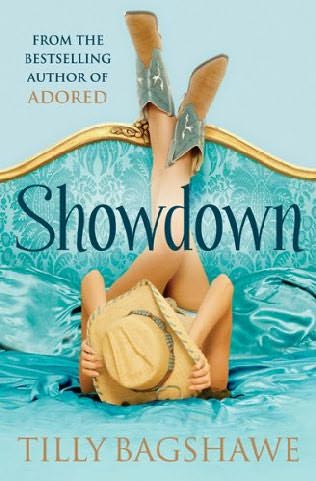
Tilly Bagshawe: Showdown

Showdown: F
Milly Lockwood Groves & Bobby Cameron


The Horse Whisperer and National Velvet meet Jackie Collins behind the barn in this libidinous fly-on-the-stall peek at horse racing and California real estate chicanery, just in time for beach read season. Irresistible Bobby Cameron, 23, and already one of the most skilled horse breakers and trainers in the world, inherits Highwood, his father's 3,000-acre California ranch, but not the money to keep it out of foreclosure.


He takes a job training two horses on a highly regarded racing stud farm in Newmarket, England, where he falls for the farm owner's 17-year-old daughter, Milly Lockwood Groves. Milly is a frustrated rider forced by her family to give up her career after a neck injury, and she's living in the shadow of her neighbor and rival, Rachel Delaney, a sexy and successful pro rider. Milly's dad has a minor stroke and finally agrees to let her return to riding and to train with Bobby at Highwood. While Milly grows closer to her dream of professional riding—and outshining Rachel—naïve Bobby takes on a sleazy partner with big bucks and an ulterior motive. (amazon)


A quite unsatisfying read… in that I wanted to throw it against the wall and curse aloud. Oh wait, I did do that. Huh..


There are several things I’d like to say about the novel and I will try my best to do it in a manner that doesn’t give away spoilers and isn’t quite so offensive. I would also add in the fact this story would probably not be classified as a romance. Probably a novel with a love story type thing.


start vent


Bobby is twenty three and Milly is seventeen. Maybe you’re thinking, ‘Aw, a story about first loves! Puppy love! How adorable!’ That most definitely is not the case. They’re young and obnoxious, and not in the least bit cute. I’m pretty sure seventeen and twenty-three years olds aren’t the smartest kids on the block, and Milly and Bobby show that very well by being superbly immature. They really do act their age. The rivalry that Milly has with neighboring rider, Rachel is so childish, it’s a little amusing. I’d expect kids in middle school to have grudges against one another as Milly and Rachel do. Oh, and the things they do to blatantly show each other they hate each other… I hope I wasn’t like that in high school.


So, the first quarter of the book is of Milly and Bobby getting acquainted with each other and introduces the reader to the world of horse racing. It also sets the groundwork for some romance. Now you might be thinking, ‘Ooh romance!’ That is also not the case. Milly and Bobby might be loving each other secretly, but they have a really funny way of showing it. Funny as in they refuse to communicate properly and have tons and tons of miscommunications.


“But Alice, 99% of romances are like that!” you might be thinking. I agree, most romances are riddled with conflict and miscommunications. However, it’s not like Showdown, where the miscommunications cause Milly to actually hook-up with another person, spurn Bobby, have their conflict last for a freaking year and a half, and have all of that shown to you in explicit detail. Are ya kidding me? Where’s the happiness? Where’s the love? Where’s the romance? Definitely not here.


Three fourths of the book was of how miserable Milly and Bobby were, not only because of their miscommunications with each other but because of the hardballs life threw at them. As Milly refused Bobby’s advice and went on to further her horse riding career, Bobby feels the repercussions of being a impulsive, rash twenty-three year old attempting to manage his father’s ranch. Milly’s career soars while Bobby’s falls. His ranch is in deep help. And it doesn’t help that Milly’s new boyfriend is the one causing Bobby tons and tons of shit. Milly, of course, is unaware, but then again, she loses herself in the world of anorexic celebrities and of Hollywood. She has great sex with her boyfriend (as does Bobby with other people), and they tell each other that they hate each other, when it’s clear that they don’t.


Realistic, yes, but agonizing to read about.


So this “little” miscommunication goes on for a good three hundred pages. And when Bagshawe has their lives fall apart, it really falls apart. It’s painful to read.


I kept reading thinking that from despair, their love will be born with even stronger fervor and passion and… no, not really.


The ending stays true to a romance in that the hero and heroine end up together. But even to the last ten pages of the book, they’re still riddled with conflict and confusion. It’s in the last three pages (literally, three) of the book that they’re together. And they love each other. (For crying out loud, they don’t even sleep together. That’s how rushed it was).


It was a magical ending, for sure, because somehow, everything came together in the worst of ways. Completely unbelievable and totally absurd. After reading three hundred pages of booze, sleazy sex, backstabbers, and mistakes, the author could have at least made their reunion great. BUT SHE DIDN’T! Agh, it killed me! Three pages? Seriously?!


I will say that it is a book that depicted Hollywood and the “fast life” pretty reasonably (or so reasonable, it seems). Then again, I’m no Britney Spears so I have no clue if people really act in the way they do in the book. All I’m saying is, if I was Milly, I’d feel pretty pissed for not having a proper get-together with my fated beloved. Grr…


/vent

Saturday, May 24, 2008

Harper Lee: To Kill a Mockingbird

To Kill a Mockinbird: B-
Scout Finch, Atticus Finch

"When he was nearly thirteen, my brother Jem got his arm badly broken at the elbow.... When enough years had gone by to enable us to look back on them, we sometimes discussed the events leading to his accident. I maintain that the Ewells started it all, but Jem, who was four years my senior, said it started long before that. He said it began the summer Dill came to us, when Dill first gave us the idea of making Boo Radley come out."

Set in the small Southern town of Maycomb, Alabama, during the Depression, To Kill a Mockingbird follows three years in the life of 8-year-old Scout Finch, her brother, Jem, and their father, Atticus--three years punctuated by the arrest and eventual trial of a young black man accused of raping a white woman. Though her story explores big themes, Harper Lee chooses to tell it through the eyes of a child. The result is a tough and tender novel of race, class, justice, and the pain of growing up. (amazon)

I’m a little sad to say that I was disappointed with this read; it’s a classic – having sold millions and translated into ten different languages within its first year of being published (and this was in 1960). It’s one of the most recommended books – both in fiction and for young adults, and many schools require their students to read it in their English classes.

I’ve heard the title of this book tossed around in so many different instances, I surely thought that it would be a much more intriguing read. Unfortunately, this was not the case.

It took me a week and a half to two weeks to finish this book, and that’s only because I thoroughly forced myself to finish (…must…read…for…Herding…cats…challenge!!...). The first two hundred pages (up to page 190 in my copy) was about Scout Finch, the eight year old daughter of a middle aged lawyer, and her older brother Jem, and their backyard adventures. Their father, Atticus, is a lawyer, and an upright person, but really, the purpose of this book – the conflict of a black man being wrongfully accused of raping a white woman – doesn’t reveal itself until roughly half the book, and when it’s first mentioned, it’s vaguely implied. The reader waits for the ball to keep rolling, and for the plot to unravel after the first mention, but the story lulls until page 192 where Atticus is actively defending Tom Robinson in court.

What happens to Jem and Scout in the long and gloomy pages before the court scene? Nothing, really. They are young kids, with Scout first being six when she is introduced. They run around with their next-door neighbor’s nephew (?) when he comes visiting in the summer. They try to make their other next door neighbor, Boo Radley, come out from his house (they’ve never seen him and there are various myths as to why he won’t reveal himself, what he does in his house – tales that were most likely concocted by these creative children). They love their father Atticus and learn about social justice and rightness from him. Scout is a tomboy and hot-headed – she gets into fights with many kids at school.

All this time, I thought, ‘How cute that I get to read about all of these things and their many adventures, but what I really want to know is the big point of this read.’ And that came at a staggeringly slow pace.

The details surrounding the charges and the accusations are made known to the reader only in the court scene – before, one is quite clueless, which makes sense since the book is from an eight year old’s point of view – yet it required much patience and many flips of pages.

However, other than the pace of the book, the story was very profound in that it discussed issues that, at the time it was written, was something that was of utmost importance (and it can be discussed that it still is). Racism, the accusations made toward Tom Robinson are atrocious and appalling. The treatment of the blacks was equally saddening, and the hypocrisy of the whites of the small Alabama town makes one think about his treatment towards others today. (Do homosexuals feel the same discrimination? Do other minority races still feel the same racism? Immigrants?...)

It was also fascinating to see the lifestyles of the people of a small Southern town in the thirties. The education system, the teaching methods, the do’s and don’ts (Auntie insisted for Scout to act like a girl, to wear a dress, no matter how much she despised it.), and the ideals that dominated the town. (And that Scout Finch is one smart cookie.)

After the courtroom scene, the pace quickened, and the ending came as a surprise but was satisfying.

In all, I understand why the book would be so highly recommended; however, I would say that the book itself is overrated and disappointing for someone who was expecting shooting stars. Furthermore, the slow pace of the book was frustrating for me – I most likely wouldn’t have finished it if I didn’t need to read it for the challenge.

Recommended, but with hesitation.